
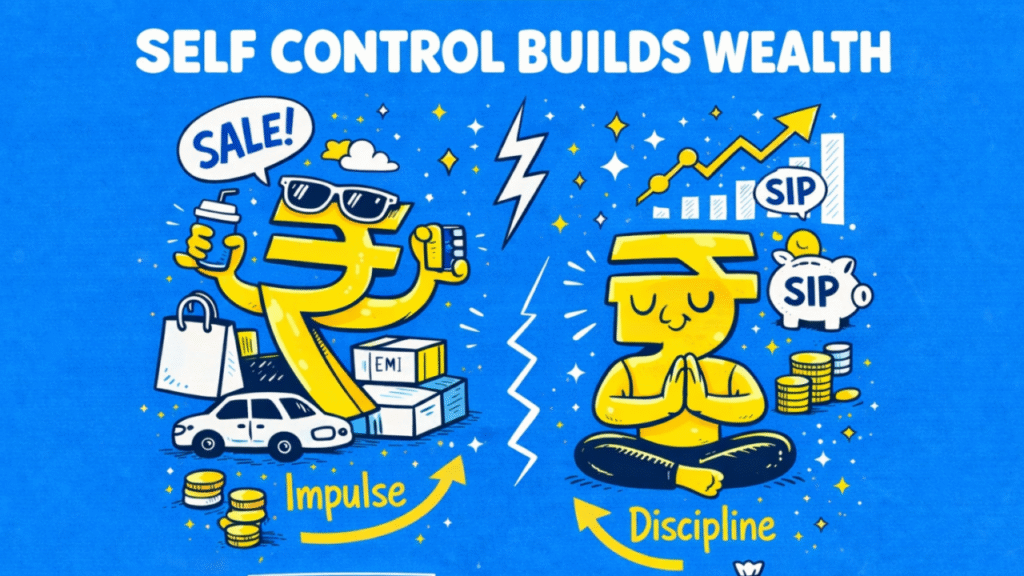
We are living in the most financially educated generation in history.
By now, most people know:
What SIP means.
What inflation does.
What compounding can achieve.
How investing early can make you financially free.
Which is good yet… most are struggling at the end of the month. Why?
Because knowledge without self control is just financial theatre.
The Age of Information and Emotional Bankruptcy
Today, financial education is everywhere.
YouTube teaches investing, Instagram talks about where to invest, Threads decode market crashes, Podcasts try to make you financially literate.
So the root cause of the problem isn’t information anymore it’s abundant, in fact but it’s Discipline.
We have mistaken access to knowledge for financial maturity because knowing what to do and actually doing it are two completely different skills.
The Most Expensive Habit No One Talks About
The real problem is Dopamine > Discipline.
Your brain is wired for immediate reward. Everytime you buy something it gives you:
A spike of excitement.
A feeling of progress.
A temporary identity boost.
Whereas investing gives you: Nothing…..
No excitement, No validation.
So your brain prefers the former.
Even if you understand investing… you still choose consumption.
The Neuroscience Behind Your Spending
Here’s what actually happens in your brain when you shop:
The moment you see something you want, your brain releases dopamine not when you buy it, but in anticipation of buying it. This is called “reward prediction.” Your prefrontal cortex (responsible for long term planning) tries to intervene, but it’s fighting an uphill battle against the limbic system (your emotional brain).
The limbic system is older, faster, and stronger. It evolved to help our ancestors survive immediate threats. It doesn’t understand “retirement in 30 years.” It only understands “I want this now.”
This is why you can read about compound interest, fully understand it, and still buy an expensive gadget the same evening. Your rational brain knows better. But your emotional brain runs the show.
The problem compounds when you add these psychological triggers:
The Endowment Effect: Once you imagine owning something, your brain treats it as already yours. Not buying it feels like a loss.
Present Bias: Your brain values ₹1,000 today far more than ₹5,000 five years from now, even though the math clearly favors waiting.
The Availability Heuristic: You remember the satisfaction from your last purchase more vividly than the abstract benefit of compounding you haven’t experienced yet.
Social Proof: When everyone around you is upgrading their lifestyle, your brain interprets restraint as falling behind triggering fear and comparison anxiety.
But over consumption doesn’t look dangerous.
It looks like:
“Just one more subscription.”
“It’s on sale.”
“I deserve this.”
“EMI makes it affordable.”
And that’s why it’s powerful.
Financial illiteracy today is not ignorance of products but it’s ignorance of behavior.
You can know everything about mutual funds and still be broke if:
Your expenses rise with every salary increment, Your lifestyle expands faster than your assets, Your identity depends on what you display.
That is not a math problem. That is a behavioral finance problem.
The Illusion of Affordability
EMIs have made everything look cheap.
That ₹1,20,000 phone? “No, just ₹3,999 per month.”
Foreign trip? – “Zero-cost EMI.”
But affordability is not about monthly payments. It is about opportunity cost.
Every ₹4,000 EMI is:
One SIP you didn’t start. One equity investment you delayed. One year of compounding you sacrificed.
Here’s the real math:
₹4,000 per month for 12 months = ₹48,000
That same ₹4,000 invested monthly at 12% annual return for 20 years = ₹44 lakhs
The phone you bought for ₹1.2 lakhs actually cost you ₹44 lakhs in future wealth.
Compounding is silent. Consumption is loud and most people choose loud.
The Dopamine Economy
Social media has turned spending into performance. You don’t just buy but
You unbox. You post. You signal status.
The brain loves novelty. It lives for validation.
But wealth is built on delayed gratification which feels boring.
That’s why financial literacy today must include:
- Understanding impulse control.
- Understanding marketing psychology.
- Understanding your own triggers.
If you can’t control consumption, no investment strategy can save you.
The Hidden Cost : Delayed Freedom
Over consumption doesn’t just cost money. It delays:
- Financial independence.
- Career flexibility.
- Risk-taking ability.
- Peace of mind.
The person with lower expenses has higher freedom. The person with lower lifestyle dependency has higher courage and courage is an underrated financial asset.
Minimalism Is Not About Less. It’s About Control and This is not about living extremely frugally.
It is about asking:
Does this purchase improve my life? Or is it filling boredom? Or is it feeding comparison?
Financial literacy is not knowing the top mutual fund of the year but it is knowing when not to buy.
The New Definition of Financial Literacy in 2026
Old definition: Knowing financial products.
New definition: Managing behavior before managing money.
Because you can:
Learn about SIPs in one weekend. Learn asset allocation in one week because you have all the resources with you at this point
But mastering consumption?
That’s a lifelong discipline.
Conclusion
Over consumption is financial illiteracy in disguise.
The world wants you to upgrade your lifestyle but Compounding wants you to upgrade your patience.
Choose wisely.
You don’t build wealth because you know more.
You build wealth because you react less.
Financial literacy without self control is comforting.
It lets you discuss money intelligently while behaving impulsively.
And that is the real scam.
Not because someone misled you.
But because you mistook knowledge for discipline.
The path forward isn’t more information, It’s more self awareness, more friction between impulse and action, more automation of good habits, more honesty about what you’re really buying.
Because at the end of the day, wealth is built in the space between wanting something and buying it.
And when you master that space, you master your financial future